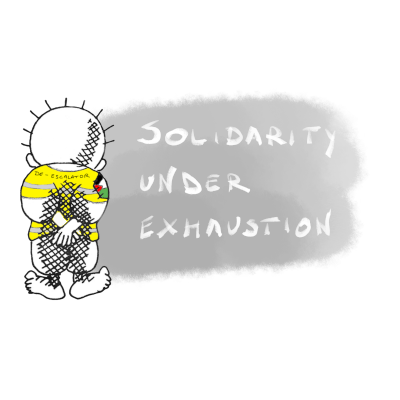
De-Escalation…. Decolonial Escalation?
About this project
This four-year (2026-2030) postdoctoral research project looks at how people in solidarity movements keep going when they are exhausted, overwhelmed, or unsure whether their efforts are making a difference. Solidarity, in this sense, isn’t only about turning out for protests—it’s about endurance: how activists support one another emotionally and relationally, and how they hold on to hope when the situation feels impossible. Many people involved in Palestine solidarity work are now asking: What next? What does solidarity even mean when governments stay silent or side with violence, when international law fails, and when civil society becomes the main space of resistance?
These questions shape the heart of this project. Since October 2023, Palestine solidarity movements across the world have faced intense pressure. In places like Germany and the UK, activists are being targeted by the state. In Belgium (where I’m from) and Finland (where I live), organising has shifted from occasional symbolic protests to more sustained, confrontational, and creative forms of action. New alliances have formed, tactics have multiplied, and activists are imagining politics differently—driven by a sense of urgency but also deep exhaustion.
This exhaustion is everywhere. Organisers are burning out, communities are disillusioned by government complicity, and many people feel overwhelmed by ongoing violence and grief. These global pressures show up in everyday organising: they shape how activists understand their role, how they adapt their strategies, and how they confront institutions that prefer silence or repression.
Solidarity movements in Belgium and Finland are not only reacting to events in Palestine; they are also trying to understand what those events reveal about their own democracies and political futures. While research on transnational solidarity has explored how tactics spread and alliances form, we know far less about how activism survives when people are tired, grieving, or facing repression. Work in feminist and care-focused scholarship shows how emotions, vulnerability, and interdependence shape political life. This project builds on those ideas and on my own position as both an activist and a researcher.
At its core, the project asks how activists themselves make sense of exhaustion and care as part of their political practice. It argues that despair isn’t just something to overcome—it can be a starting point for building forms of care, friendship, camaraderie, and refusal. These everyday practices create “infrastructures of endurance” that keep movements going and sustain political imagination long after a protest ends.
By centring the voices and experiences of activists and treating them as thinkers of their own movements, the project traces how organising in Belgium and Finland responds to violence and institutional complicity. In doing so, it aligns with the Kone Foundation’s commitment to supporting free, diverse, and community-rooted research. Ultimately, it shows that solidarity lives not only in moments of public protest but also in quiet acts of care, connection, and shared vulnerability.
Who’s involved?
The list of people involved can be found here. It looks a bit lonely at the moment, but more people will get involved over time.
Research environment
The Solidarity under Exhaustion project finds it home in the Geographies of Coloniality and Everyday Violence Research Group (GOCEP).
Where I buy my books

I get all my books from Libristo, an independent online bookstore that can get you any book you want without people having to pee in bottles as they “fulfill” your order.
You can use this discount voucher code at checkout 2391268278. You can redeem the discount voucher by entering the voucher number once you’ve completed your order.
BDS
Solidarity under Exhaustion fully endorses the Palestinian call for Boycott, Divestment, and Sanctions (BDS), in this case first and foremost the Academic Boycott. In line with this, the project does not and will not cooperate with Israeli institutions complicit in the occupation and violation of Palestinian rights. Academic freedom must never be used to shield systemic violence and oppression. Silence and neutrality in the face of genocide are forms of complicity.
Images
Some are mine, some by others (always credited). Some of the drawing are by Eero, like the “What’s this all about?” illustration.
Funding
This project is funded by the Kone Foundation. Grant number: 202504043.